"When your job hinges on how well you talk to people, you learn a lot about how to have conversations — and that most of us don't converse very well. Celeste Headlee has worked as a radio host for decades, and she knows the ingredients of a great conversation: Honesty, brevity, clarity and a healthy amount of listening. In this insightful talk, she shares 10 useful rules for having better conversations. "Go out, talk to people, listen to people," she says. "And, most importantly, be prepared to be amazed."
Thursday, April 07, 2016
Celeste Headlee: 10 ways to have a better conversation | TED Talk | TED.com
Celeste Headlee: 10 ways to have a better conversation | TED Talk | TED.com


Thursday, November 19, 2015
These 29 Clever Drawings Will Make You Question Everything Wrong With The World
Polish artist Pawel Kuczynski has worked in satirical illustration since 2004, specializing in thought-provoking images that make his audience question their everyday lives. His subjects deal with everything from social media to politics to poverty, and all have a very distinct message if you look closely enough…
These 29 Clever Drawings Will Make You Question Everything Wrong With The World
These 29 Clever Drawings Will Make You Question Everything Wrong With The World
Thursday, June 06, 2013
How to: Enjoy Paris for free | Matador Network
How to: Enjoy Paris for free | Matador Network
On our last evening, we were having a meal on the mattress–cheese, pâté, wine–when a girl came into the apartment to take away all of the furniture.
It was embarrassing—our friend had forgotten to tell us she would be coming, and had forgotten to tell her that we would be there—but in broken language we all apologized until we were weary of apologizing, and then helped her unhook the washing machine from the wall.
We slept without a mattress that night, sweating profusely in the late August heat, but it was okay, somehow—and it was free.
Curated by Stillmind on June 6th, 2013
Youthful Fortune (excerpt)
By lucky, youthful fortune, a friend of ours turned out to have a crumbling apartment in the Latin Quarter that we could stay in, as long as we were out by the end of the weekend—he’d recently sold the place and new ownership was soon to take effect.On our last evening, we were having a meal on the mattress–cheese, pâté, wine–when a girl came into the apartment to take away all of the furniture.
It was embarrassing—our friend had forgotten to tell us she would be coming, and had forgotten to tell her that we would be there—but in broken language we all apologized until we were weary of apologizing, and then helped her unhook the washing machine from the wall.
We slept without a mattress that night, sweating profusely in the late August heat, but it was okay, somehow—and it was free.
Monday, December 24, 2012
Men and Women Can't Be "Just Friends": Scientific American
Curated by me, today.
 I just don't think about you that way. Image: iStock/Skip O'Donnell
Can heterosexual men and women ever be “just friends”? Few other questions have provoked debates as intense, family dinners as awkward, literature as lurid, or movies as memorable. Still, the question remains unanswered. Daily experience suggests that non-romantic friendships between males and females are not only possible, but common—men and women live, work, and play side-by-side, and generally seem to be able to avoid spontaneously sleeping together. However, the possibility remains that this apparently platonic coexistence is merely a façade, an elaborate dance covering up countless sexual impulses bubbling just beneath the surface.
New research suggests that there may be some truth to this possibility—that we may think we’re capable of being “just friends” with members of the opposite sex, but the opportunity (or perceived opportunity) for “romance” is often lurking just around the corner, waiting to pounce at the most inopportune moment.
In order to investigate the viability of truly platonic opposite-sex friendships—a topic that has been explored more on the silver screen than in the science lab—researchers brought 88 pairs of undergraduate opposite-sex friends into…a science lab. Privacy was paramount—for example, imagine the fallout if two friends learned that one—and only one—had unspoken romantic feelings for the other throughout their relationship. In order to ensure honest responses, the researchers not only followed standard protocols regarding anonymity and confidentiality, but also required both friends to agree—verbally, and in front of each other—to refrain from discussing the study, even after they had left the testing facility. These friendship pairs were then separated, and each member of each pair was asked a series of questions related to his or her romantic feelings (or lack thereof) toward the friend with whom they were taking the study.
The results suggest large gender differences in how men and women experience opposite-sex friendships. Men were much more attracted to their female friends than vice versa. Men were also more likely than women to think that their opposite-sex friends were attracted to them—a clearly misguided belief. In fact, men’s estimates of how attractive they were to their female friends had virtually nothing to do with how these women actually felt, and almost everything to do with how the men themselves felt—basically, males assumed that any romantic attraction they experienced was mutual, and were blind to the actual level of romantic interest felt by their female friends. Women, too, were blind to the mindset of their opposite-sex friends; because females generally were not attracted to their male friends, they assumed that this lack of attraction was mutual. As a result, men consistently overestimated the level of attraction felt by their female friends and women consistently underestimated the level of attraction felt by their male friends.
Men were also more willing to act on this mistakenly perceived mutual attraction. Both men and women were equally attracted to romantically involved opposite-sex friends and those who were single; “hot” friends were hot and “not” friends were not, regardless of their relationship status. However, men and women differed in the extent to which they saw attached friends as potential romantic partners. Although men were equally as likely to desire “romantic dates” with “taken” friends as with single ones, women were sensitive to their male friends’ relationship status and uninterested in pursuing those who were already involved with someone else.
Men and Women Can't Be "Just Friends": Scientific American
Researchers asked women and men "friends" what they really think—and got very different answers
I just don't think about you that way. Image: iStock/Skip O'Donnell 
-

What a Plant Knows
How does a Venus flytrap know when to snap shut? Can it actually feel an insect’s tiny, spindly legs? And how do cherry blossoms know when to bloom? Can they...
Read More »
New research suggests that there may be some truth to this possibility—that we may think we’re capable of being “just friends” with members of the opposite sex, but the opportunity (or perceived opportunity) for “romance” is often lurking just around the corner, waiting to pounce at the most inopportune moment.
In order to investigate the viability of truly platonic opposite-sex friendships—a topic that has been explored more on the silver screen than in the science lab—researchers brought 88 pairs of undergraduate opposite-sex friends into…a science lab. Privacy was paramount—for example, imagine the fallout if two friends learned that one—and only one—had unspoken romantic feelings for the other throughout their relationship. In order to ensure honest responses, the researchers not only followed standard protocols regarding anonymity and confidentiality, but also required both friends to agree—verbally, and in front of each other—to refrain from discussing the study, even after they had left the testing facility. These friendship pairs were then separated, and each member of each pair was asked a series of questions related to his or her romantic feelings (or lack thereof) toward the friend with whom they were taking the study.
The results suggest large gender differences in how men and women experience opposite-sex friendships. Men were much more attracted to their female friends than vice versa. Men were also more likely than women to think that their opposite-sex friends were attracted to them—a clearly misguided belief. In fact, men’s estimates of how attractive they were to their female friends had virtually nothing to do with how these women actually felt, and almost everything to do with how the men themselves felt—basically, males assumed that any romantic attraction they experienced was mutual, and were blind to the actual level of romantic interest felt by their female friends. Women, too, were blind to the mindset of their opposite-sex friends; because females generally were not attracted to their male friends, they assumed that this lack of attraction was mutual. As a result, men consistently overestimated the level of attraction felt by their female friends and women consistently underestimated the level of attraction felt by their male friends.
Men were also more willing to act on this mistakenly perceived mutual attraction. Both men and women were equally attracted to romantically involved opposite-sex friends and those who were single; “hot” friends were hot and “not” friends were not, regardless of their relationship status. However, men and women differed in the extent to which they saw attached friends as potential romantic partners. Although men were equally as likely to desire “romantic dates” with “taken” friends as with single ones, women were sensitive to their male friends’ relationship status and uninterested in pursuing those who were already involved with someone else.
Men and Women Can't Be "Just Friends": Scientific American
Sunday, June 17, 2012
Friday, November 25, 2011
Tuesday, August 02, 2011
Somalia famine: Minister warns of starvation in rebel controlled areas | Global development | guardian.co.uk
Curated by Stillmind
August 2nd- 2011.
Somalia famine: Minister warns of starvation in rebel controlled areas | Global development | guardian.co.uk
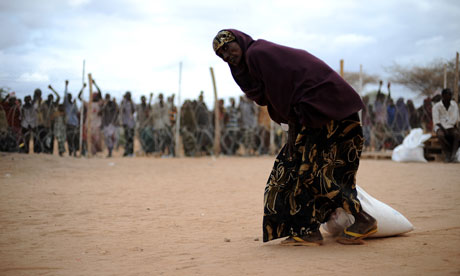
Somalia's deputy prime minister tells FAO meeting that people in areas controlled by Al-Shabaab may starve to death if aid does not reach them in the next few weeks
A Somali refugee drags a sack with food aid given to her at a food distribution point at the Dadaab refugee camp this week. Photograph: Roberto Schmidt/AFP/Getty
Somalia's deputy prime minister tells FAO meeting that people in areas controlled by Al-Shabaab may starve to death if aid does not reach them in the next few weeks
The vast majority of people in insurgent-controlled areas of Somalia may starve to death unless aid reaches them in the next few weeks, said Mohamed Ibrahim, Somalia's deputy prime minister.
Ibrahim's blunt warning came at an emergency summit in Rome organised by France, the current president of the G20, and the Foodand Agriculture Organisation (FAO) as the world community seeks to mobilise help to relieve Somalia's first famine in 18 years.
Somalia's deputy prime minister said the fundamental cause of the famine was the fragility of the state and enduring conflict that has hindered the provision of basic services. He also blamed insurgents who have blocked lifesaving aid.
"The plight of the Somali people is desperate," said Ibrahim. "We have witnessed suffering in the heart of the capital."
Access to affected regions has emerged as a key problem in the current crisis. Last week, the UN declared a famine in two regions of Somalia southern Bakool and Lower Shabelle. Somali Islamist rebels, who control these areas, last week denied lifting a ban on certain aid groups indrought-affected areas and rejected the UN's claim that there is a famine in the region.
Earlier this month, the rebel group al-Shabaab, which controls much of southern Somalia, had said earlier this month that it would allow all humanitarian groups access to assist with the drought response. But al-Shabaab spokesman Sheikh Ali Mohamud Rage told a local radio station on Friday that the ban on specific aid agencies, which was imposed in 2009 and 2010, still stands.
At the time, the rebels accused various humanitarian groups, including the UN's World Food Programme (WFP), which is expected to lead the current drought response, of damaging the local economy, being anti-Muslim, and of spying for the government.
An estimated 11.6 million people need humanitarian assistance in Somalia, Ethiopia, Kenya and Djibouti, according to the UN.
As G20 leaders met in Rome, Save the Children warned that the number of malnourished children in 14 of its feeding centres in camps in Puntland, northern Somalia, has doubled from 3,500 to 6,000 in just two weeks.
The number of acutely malnourished children – and those who will die without emergency assistance – has also doubled, rising from 300 children to 600 in the last two weeks at the charity's clinics in Puntland.
Médecins Sans Frontières (MSF) said its feeding centres were operating beyond their original capacity and, compared to last year, they were receiving up to seven times more patients in certain locations each week. MSF said "spontaneous camps" are emerging in various locations, such as in the Lower Juba Valley.
Save the Children said if world leaders at the emergency meeting fail to plug a $1bn (£613m) funding gap for the east Africa aid effort, more than a million children could die in Somalia alone.
Save the Children pointed out that, despite organising the meeting, the French government has donated just £1.6m to the aid effort, lagging far behind the UK government's recent £52m donation. Italy – the host of today's summit and Europe's fourth largest economy – has contributed only £550,000. Norway told the FAO meeting that it was ready to contribute more money to the relief effort, while the EU has increased its funding to euros 100m. It hopes to increase this further to euros 160m.
Funding commitments
In a pointed intervention, Jeffrey Sachs, special adviser to the UN on the millennium development goals, said the world needed to turn to the Gulf states if it was serious about raising money quickly.
"We have to look to the Gulf states," he said. "It is the only place where the money really is. This is a room of governments without money."
In a later press conference, Kanayo Nwanze, the head of the International Fund for Agricultural Development, a UN special agency, chastised the lack of political leadership in Africa in supporting agriculture.
"If Africa does not get its house in order and expects the world to help us out, we are dreaming," said Nwanze. "Thank goodness Tanzania, Kenya and Ghana are moving ahead with agriculture."
He criticised African governments for not keeping their 2003 promise to earmark 10% of their budgets for agriculture.
"Less than 10 countries have fulfilled that pledge," he said.
The World Bank promised to provide more than $500m to help drought victims. The money would be spent on projects in Ethiopia, Kenya, Djibouti and Somalia, including the worst-stricken areas in that country "where circumstances permit", the bank said.
"The recurring nature of drought and growing risk it poses to social and economic gains in this region calls not only for immediate relief from the current situation, but also for building longterm drought resilience," said Obiageli Ezekwesili, World Bank vice-president for Africa.
Opening the meeting, the FAO's director general, Jacques Diouf, said there was a need for greater co-ordination in response to the drought and famine in east Africa to "save our brothers and sisters of dying of thirst and hunger".
He said the world was faced with a similar crisis in the region in 2000, which prompted the then secretary general of the UN, Kofi Annan, to appoint an inter-agency taskforce to investigate what could be done to make the region more food secure.
The resulting report, The elimination of food insecurity in the Horn of Africa: A strategy for concerted government and UN agency action, recommended each of the seven countries in the area draft food security programmes, the implementation of regional food security programmes, expanding markets and trade opportunities, and improving in-country health and nutrition.
The report said large-scale infrastructure was needed alongside investment in small-scale projects, particularly in rural roads, livestock markets and basic services, "ensuring that these developments are community-driven".
Diouf drew parallels with the recommendations made in the report by the taskforce, which he led, and the situation now. He pointed out that irrigation was an important component in addressing the crisis. Just 1% of land in the effected region was irrigated in 2000, he said.
Little appears to have been done to increase this figure. An estimated 2% of land in eastern and southern Africa is believed to now have an irrigation system in place; only about 7% of land in the whole of Africa is irrigated, compared with more than 30% of land in Asia.
Diouf said the 2000 crisis was averted and international attention drifted to other issues. "Must history always repeat itself?" he asked. "And in the first few years of the 21st century, must the international community go through the agonising spectacle of seeing children and livestock dying, as in ancient Egyptian times?
"My hope is that the international community and the G20 in the next few years will marshal enormous resources so in the future such tragic events are nothing more than a bad memory ... that fields will be irrigated and roads will be built so the region will no longer weigh on our collective conscience."
The executive director of the World Food Programme, Josette Sheeran, said the current crisis stemmed from a "triple storm" of drought, soaring food prices and conflict.
Tuesday, July 12, 2011
Mass psychosis in the US - Opinion - Al Jazeera English
| Mass psychosis in the US | ||
How Big Pharma got Americans hooked on anti-psychotic drugs.
James Ridgeway Last Modified: 12 Jul 2011 06:20
| ||
Once upon a time, antipsychotics were reserved for a relatively small number of patients with hard-core psychiatric diagnoses - primarily schizophrenia and bipolar disorder - to treat such symptoms as delusions, hallucinations, or formal thought disorder. Today, it seems, everyone is taking antipsychotics. Parents are told that their unruly kids are in fact bipolar, and in need of anti-psychotics, while old people with dementia are dosed, in large numbers, with drugs once reserved largely for schizophrenics. Americans with symptoms ranging from chronic depression to anxiety to insomnia are now being prescribed anti-psychotics at rates that seem to indicate a national mass psychosis. It is anything but a coincidence that the explosion in antipsychotic use coincides with the pharmaceutical industry's development of a new class of medications known as "atypical antipsychotics." Beginning with Zyprexa, Risperdal, and Seroquel in the 1990s, followed by Abilify in the early 2000s, these drugs were touted as being more effective than older antipsychotics like Haldol and Thorazine. More importantly, they lacked the most noxious side effects of the older drugs - in particular, the tremors and other motor control problems. The atypical anti-psychotics were the bright new stars in the pharmaceutical industry's roster of psychotropic drugs - costly, patented medications that made people feel and behave better without any shaking or drooling. Sales grew steadily, until by 2009 Seroquel and Abilify numbered fifth and sixth in annual drug sales, and prescriptions written for the top three atypical antipsychotics totaled more than 20 million. Suddenly, antipsychotics weren't just for psychotics any more. Not just for psychotics anymore... |

Monday, May 30, 2011
Sunday, May 22, 2011
BBC News - Could the insurgents be defeated in Afghanistan?
BBC News - Could the insurgents be defeated in Afghanistan?
22 May 2011
(Video)>
http://www.bbc.co.uk/news/world-south-asia-12981618

22 May 2011
(Video)>
http://www.bbc.co.uk/news/world-south-asia-12981618
Suicide bombers storm Afghan police base
Suicide bombers wielding machine guns have stormed a government building in eastern Afghanistan, officials say.
Initial reports say at least three gunmen wearing suicide vests shot their way into the traffic police headquarters in Khost city.
Security forces have surrounded the compound and a gun battle is taking place, police say. At least one person is reported to have been killed.
The attack comes a day after a suicide bombing in Kabul killed at least six.
In the latest attack, a guard was killed in the initial assault which happened at about 0500 (0030 GMT) on Sunday, said Gen Raz Mohammad Oryakhail, army commander for Khost province.
He said the militants were on the second floor of the building and shooting down at police and soldiers outside.
However, a provincial police chief told AFP news agency that three police officers had been killed.
Another official said police and troops were trying to avoid a full-scale assault because they didn't want the gunmen to detonate their suicide vests.
In Saturday's attack, a suicide bomber detonated his device in a tent in the grounds of Charsad Bestar Hospital where medical students were eating lunch.
Although the hospital treats Afghan military personnel, the victims were all civilians and medical students, police said.
The Taliban said it carried out the attack.
Subscribe to:
Posts (Atom)
