July 25th, 2010
The Mysterious Disappearance of Sean Flynn
and Dana Stone
by René Volpi
Thanks to Tim King
Salem-News.com
Forty years have passed since my friends, war photographers Sean Flynn and Dana Stone dropped off the radar. What we know,
what we don't know, and what we may soon learn.
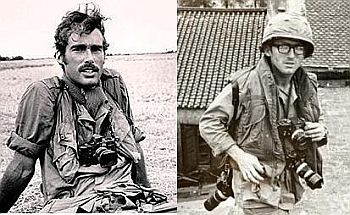
Sean Flynn and Dana Stone |
Forty years after the disappearance of Vietnam War photographers Sean Flynn and Dana Stone, we stand on the verge of possibly learning their ultimate fate. Flynn's name made the news a little over a week ago, when it was announced that remains recovered in Cambodia could be his.
The son of legendary actor Errol Flynn, went missing in Cambodia on 6 April 1970, along with Stone. For 40 years, the world has wondered what happened to remove these vivacious, talented men permanently from the world. Books, a song and a play have been written; a movie by their friend and colleague Tim Page called "Frankie's House" was loosely based on real events surrounding the lives of these journalists who didn't just live at the edge, but managed to go past it. Competition was fierce and deals, all kinds of deals were forged all over the place.
One person who has never forgotten about Sean Flynn-- besides me--for he was a very dear friend who took me for rides on the back of his motorcycle, is his half-sister, Rory Flynn. She organized the recent excavation of the gravesite that could contain the remains of her long lost brother.
Initial reports on the recovery of the remains in Cambodia were apparently skewed, and the group working with Rory Flynn says the truth of what happened was not conveyed in a proper context by a number of media outlets.
Investigator Dave MacMillan, told
Salem-News.com that his team acted with the consent of the Cambodian military, local police, local community leaders and landowners, and with the full knowledge of JPAC, (Joint Prisoners of War, Missing in Action Accounting Command) in Hawaii.
MacMillan said, "We are not amateur bone hunters, we volunteered to help Rory on her mission and worked as her field agents and did not receive payment for what we have done and are still doing, both Mr.Scott Brantley who is a registered private investigator from Nashville Tennessee and myself have combined 35 years of investigation experience between us."
"Did they want to get captured? They never said anything like that to me or to others then working in Cambodia that I know of. They pushed the envelope, but knew the risks were extreme. Stone was very level headed, but Sean played high stakes." - Jeff Williams
Declassified CIA document on civilian POW's in Cambodia
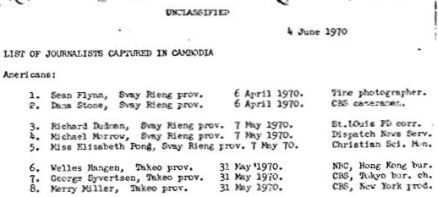
Mike Luehring, a representative of the Flynn family, contacted
Salem-News.com after our first report, to confirm the statements of Dave MacMillan, and the importance of informational accuracy.
Citing the "crazy press coverage of the event", Luehring wrote, "I've followed your coverage and appreciate your accuracy on the story." We always appreciate the verification; stories of this magnitude should never be sensationalized, yet they are, and this was no exception.
I have been in contact with a number of people who knew Dana Stone and Sean Flynn, and the list is growing. One person highly significant to the story, is T. Jeff Williams, who was in Phom Pehn on 6 April 1970.
He says our description of the last sight of Sean Flynn is not complete accurate, based on his memory, and he is indeed someone who would know. Jeff Williams was the only American AP correspondent in Cambodia when the 18 March 1970 coup occurred. He is among the last to see Sean and Dana.
Snapshot: Vietnam War 1970
To fully understand this point in the Vietnam War, and the complex, politically sensitive decision to invade Cambodia in 1970, you must consider that communists had been using Cambodia for a long time,
unofficially, to fight a war against South Vietnam and the United States.
I wasn't even nineteen then yet, but in working with the people who were there earlier, in this years-long quest for information, I am reminded of how quickly stories can change, and the extreme importance of first-hand accounts.
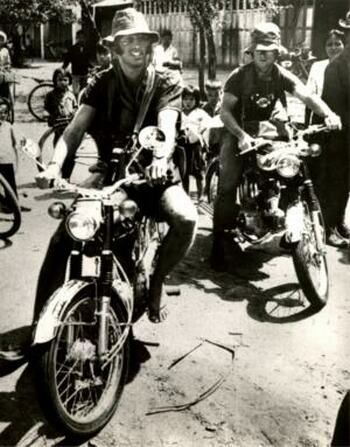
The last picture taken of Sean Flynn and Dana Stone, in Cambodia, shortly before they were taken captive at a Communist
checkpoint. Photo courtesy: Stephen Bell
|
The War in Vietnam officially began after the November 1964 attack on the U.S.S. Maddox, a Navy destroyer operating in the Gulf of Tonkin. The shots reportedly fired by the North Vietnamese vessel were a matter of contention for years in the U.S. People believed the story was contrived as a reason for war. Interestingly, since the 1990's, the Vietnamese have displayed artifacts from a vessel in a museum that they claim was involved in the attack on the Maddox.
In the beginning there was a great deal of public support, not that most people had the
slightest idea where Vietnam was.
But support and enthusiasm began to wane as the years passed, falling as the death toll kept rising. Americans were not used to seeing a bloody war being fought every night on the evening news, but that quickly became part of the American indoor landscape.
Then came the Tet Offensive in 1968, which it happened before my time there, and with it a high price for all those present.. The highly orchestrated series of communist attacks staged by the North Vietnamese Army and Viet Cong on the Chinese holiday, was costly for the communists who lost many of their fighters all over South Vietnam. The cost for Americans, in addition to the military casualties, was that the attack came to represent a turning point in the war. It was Walter Cronkite, who would later be integral in search efforts for Sean and Dana, who proclaimed to the nation that the war in Vietnam could no longer be won.
Cambodia had officially been neutral during the Vietnam War, but it was no secret that communist forces used Cambodia frequently to travel and stage operations, many of them utilizing the infamous Ho-Chi Ming trail.
Cambodia's royal leader, Prince Norodom Sihanouk, was losing popular support over the growing presence of communists in his country. Khmer Rouge guerrilla fighters were growing and becoming increasingly organized.
While Sihanouk was in Moscow, on 18 March 1970, General Lon Nol took control of the government of Cambodia. With little patience for the communist insurgency, Lon Nol decided to go after tens of thousands of Vietnamese communists in eastern Cambodia, where a number of bases were maintained to support operations against the Americans and South Vietnamese.
According to historical accounts, Lon Nol tried to block the communists from using Sihanoukville, a main supply route, while demanding that their troops leave his country.
Answers.com states, "With their supply system threatened, the Vietnamese communist forces in Cambodia launched an offensive against Lon Nol's government. As the Cambodian forces faltered, the United States decided to mount a limited incursion to save Lon Nol's government. Destroying the communist base areas on the Cambodian border would also inhibit enemy operations in South Vietnam."
I read an article this week that compared these teenagers of the Khmer Rouge, with those who came to comprise what we now know as the Taliban.
The press crews in Cambodia in early April 1970 were in many respects, on their own. This was the situation for Sean Flynn, Dana Stone and so many others.
Twenty days after the two disappeared, on 26 April 1970, President Richard Nixon's approval was given for a multi division offensive into Cambodia.
'Operation Rover' assigned the U.S. Army's First Cavalry Division's Bravo Troop as one of the units to take part in the operation. While there was clearly a measured degree of success in Cambodia, this marked, or confirmed in some cases, the beginning of the end to the conflict, as stated on the Website for the Air Cav's Bravo Troop:
"The campaign had severe political repercussions in the United States for the Nixon Administration. Pressure was mounting to remove America's fighting men from the Vietnam War. Although there would be further assault operations, the war was beginning to wind down for many troopers."
No Witnesses to Disappearance
Jeff Williams' distinction of being the only American AP correspondent in Cambodia when the 18 March 18 1970 coup occurred, was part of a six-month assignment. During those approximately 180 days, 25 foreign journalists were killed--murdered--or disappeared. Jeff was around Sean and Dana in Cambodia, and he know them from working in Vietnam.
He says that in spite of the widely reported information about the two combat photographers electing to turn themselves into communist guerrillas, there is no definitive proof that Flynn and Stone rode up to a checkpoint at all.
He said, "No one was in sight behind that car that blocked the road. No 'guards' or Khmer Rouge. Sean and Dana rode up close to it, checked it out and came back to where the group of other journalists were hanging around, said they saw nothing and then decided to look on the other side. That's when they disappeared."
The car that Jeff refers to was photographed by Zalin Grant. It was a white sedan, parked sideways in the road to prevent traffic from passing. It is reported that communist guerrillas were in the woods adjacent to the car, with an ambush waiting for anyone who came close.
200 Armed Cambodian Tour Guides
The press tour that Zalin Grant was part of that day, arrived at Chi Pou around noon. American reporters in Phnom Penh had talked the government information office into providing eight French armored cars, along with 200 Cambodian soldiers, to escort the newsmen into the combat zone.
This is where things begin to become unclear. The story about Dana Stone and Sean Flynn deciding to be captured, if it is true, is almost certainly based on what happened to a former Cover Girl model, Michèle Ray, who had been taken captive by Khmer Rouge, and was released unharmed within a week. This happened shortly before Flynn and Stone disappeared.
Of this notion, Zalin Grant wrote, "Sean Flynn had talked to me admiringly many times about how Michèle had gotten away with it."
But that still isn't proof.
One person who knew something about this was Roxanna Brown, the youngest credentialed photographer in Vietnam at one point. She reportedly stayed overnight with Sean Flynn, the night before he went missing. She died in 2008 in federal custody at Seattle's Sea Tac Airport, because she was refused medical attention. Her family was paid close to a million dollars over the associated negligence.
Jeff Williams has a different take on Dana Stone and Sean Flynn's last day of freedom.
"Did they want to get captured? They never said anything like that to me or to others then working in Cambodia that I know of. They pushed the envelope, but knew the risks were extreme. Stone was very level headed, but Sean played high stakes."
Zalin explains that most of the news people were staying around a village that had recently been destroyed. Many were thinking about three friends; two Japanese TV reporters and a French photographer, whose car appeared to be the one blocking the road ahead of them. There are discrepancies about that as well.
"Sean and Dana were traveling with another photojournalist, René Volpi from Magnum, when they saw the car from a distance, they stopped and sat a few minutes on their Hondas, trying to make up their minds what to do. When word came of trouble at the checkpoint, the Cambodian troop commander (or the "good guys", which fought the Khmer Rouge) ordered the entire escort force to return to the safety of the nearest provincial capital".
According to Zalin Grant, "One of them turned on his camera as Flynn cycled toward them, warning, 'Pathet Lao! Pathet Lao!' It was a measure of his excitement that he confused the guerrillas of Cambodia with those of Laos."More time passed, and then a French TV crew that René from Magnum had summoned were sent back in the direction of Sean and Dana. What happened only adds to the mystery.
- Sean Flynn, Svat Rieng prov. 6 April 1970 Time photographer
- Dana Stone, Svat Rieng prov. 6 April 1970 CBS cameraman
- Richard Dudran, Svat Rieng prov. 7 May 1970 St. Louis PD COrr.
- Michael Morrow, Svat Rieng prov. 7 May 1970 Dispatch News Serv.
- Miss Elizabeth Pong, Svat Rieng prov. 7 May 1970 Christian Sci. Mon.
- Welles Rangen, Takeo Prov. 31 May 1970 NBC Hong Kong bur.
- George Syvertsen, Takeo Prov. 31 May 1970 CBS Tokyo bur. ch.
- Merry Miller, Takeo Prov. 31 May 1970 CBS New York prod.
Strangely, Dana Stone was nowhere to be seen at this point. René and Sean had convinced the French TV crew to turn around, but Sean stayed in the area. That is from what we can tell, the very last time that a western person saw either Sean Flynn or Dana Stone.
A couple of days later, more journalists were taken at a checkpoint, and the number of missing news people kept rising. Soon eleven newsmen were missing, along with two French teachers who had been captured. It was shocking for the local press corps.
Another key person in all of this, is Sean Flynn's old friend Tim Page, who has never given up his interest in locating his old friend.
The CIA's Electronic Reading Room publishes many documents that are now declassified. A search of their records for 'Sean Flynn' and 'Dana Stone' reveals some interesting information, some of which I was not particularly familiar with.
(will be continued in the next Post)